The production meeting on a Tuesday night, working out who has sold what.
Most amateur dramatic societies in the UK have run a show this way for decades, and most of it works. Seaty grew out of that world rather than against it. The reservations, the quotas, the comps, the programmes, the Gift Aid, the rehearsal recordings going out to the chorus on Monday, in one place, with a free option for societies handling payment themselves.
Ticketing software for amateur dramatic societies.
Seaty is used by UK amateur dramatic societies, including NODA-affiliated companies, school musicals, and community theatre groups hiring rooms in their local independent theatre. The same member tracking applies if your society is closer to a choir or orchestrarunning a concert season. Free for societies taking payment themselves through cash, cheque, or bank transfer.
Reserved seating for amateur theatre venues.
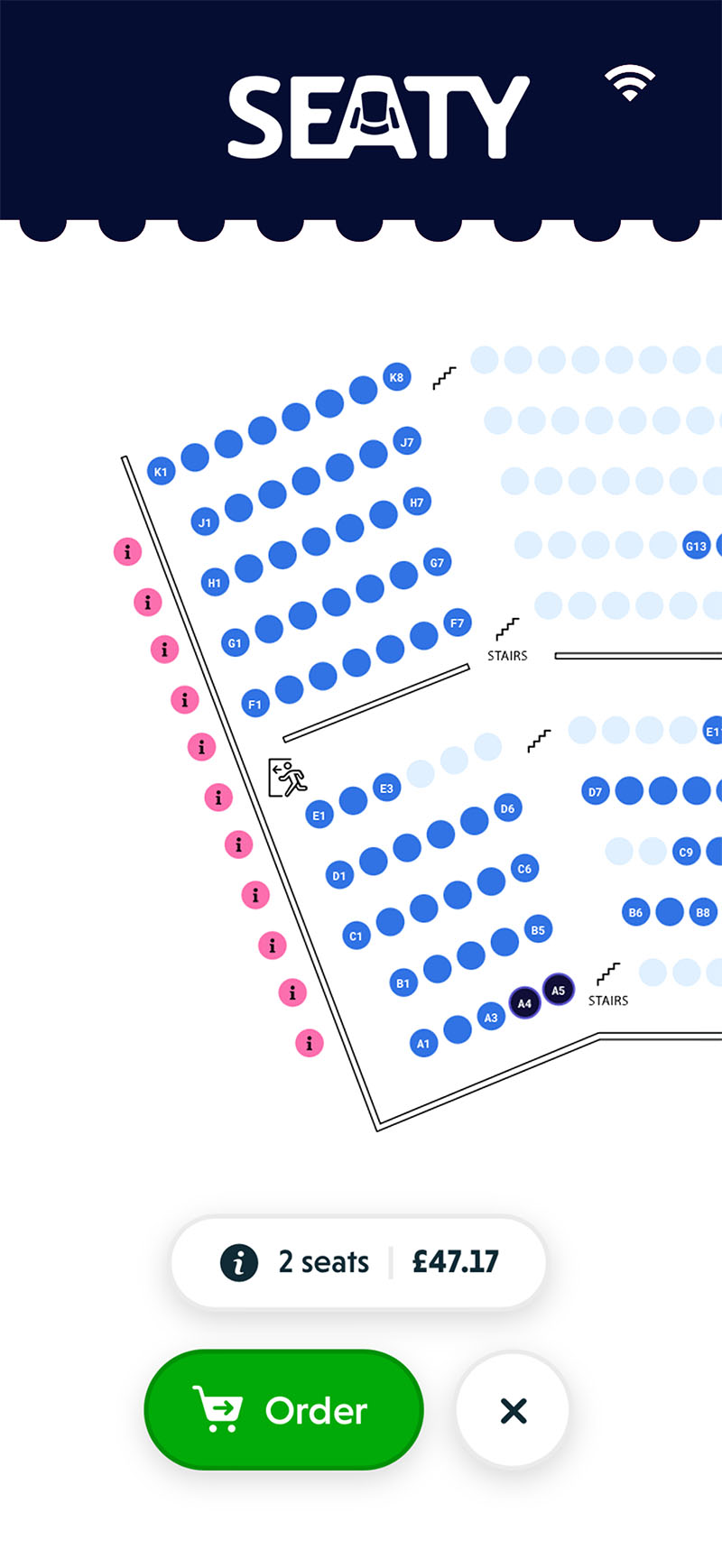
Build the hall, studio, or hired theatre as a visual seating plan. Audience members pick their own seats with live availability, and the box office, the front-of-house team, and members on their phones all see the same plan. A typical UK amateur dramatic society running a five-night run in a 150-seat hall might hold two performances on the visual plan and the matinee on simple general admission, which Seaty supports side by side. The trade-offs between reserved seating and general admission are covered in our related guides. The outcome: nobody at the foyer table on opening night is fielding the question of where exactly row F is.
- Visual editor for any venue layout, from a 60-seat studio to a 400-seat civic theatre
- Sections for stalls, circle, balcony, and side seating
- Accessible seats, companion seating, and restricted-view seats marked clearly
- Members and box office staff can hold seats while a customer decides
- Works on phones for buyers and on any tablet for the box office
- General admission supported alongside reserved seating for matinees and previews
Reservations agreed at the production meeting before money changes hands.
Seaty makes that a first-class workflow. Approved members reserve seats from their phone, the committee approves or denies, and the seat is held against the audience member with whatever has been agreed: pay on the night, pay by bank transfer, pay in instalments. The treasurer sees outstanding balances across the whole production. Auntie's front row Thursday is held without anyone writing it on a clipboard, and nothing is forced through an instant checkout if that is not how the society works.
This is what Seaty is built for.
Selling tickets through cast members.
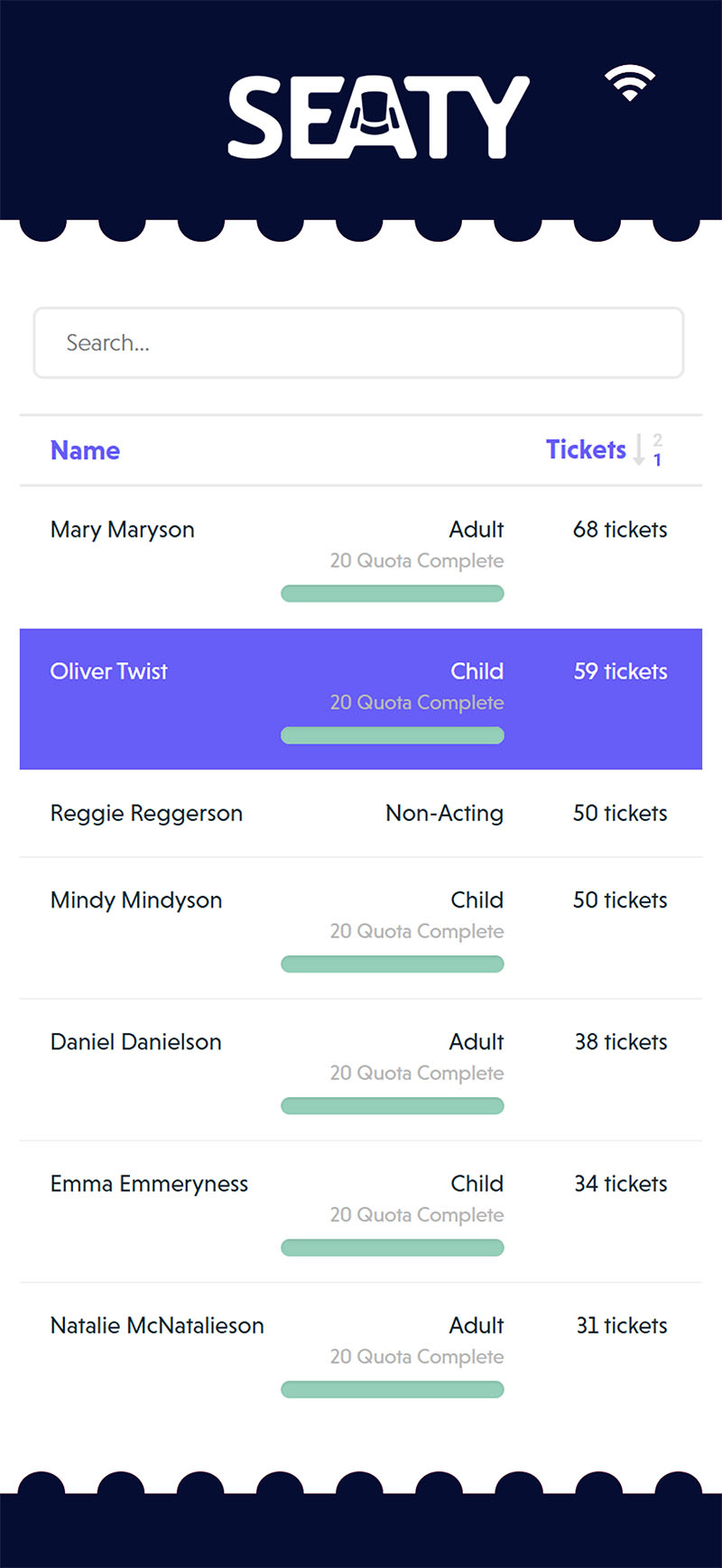
Most ticketing platforms break down the moment you try to allocate tickets at a production meeting. There is no concept of a member selling on behalf of the society, only a buyer at a checkout. The society allocates a quota of tickets to each cast member to sell to family and friends. John has twelve, the chorus have six each, the principals have a few more, and the production manager wants the running total before next Tuesday. Seaty tracks every sale against the member it belongs to, in real time, with a view of who has sold what, who has been paid, and who is still carrying a balance. The same approach used by UK choral societies and amateur orchestras on Seaty, applied to a theatrical production. The outcome: no more chasing cast members for money after the show closes.
- Set quotas per member or per group, for example twelve for principals and six for chorus
- Members see their own progress and balances on their phone
- Sales counted against the right member when buyers reference them at checkout
- Production team sees who is on track and who needs a nudge
- Outstanding balances visible across the whole production at a glance
Member quotas, running balances, end-of-season statements.
Cast and crew complimentary allocations.
The slice of the house held back for the people putting on the show

A row at the back for the cast on closing night. A handful of seats on the dress rehearsal preview for the families that drove people to rehearsal. A few comps for the technical team across the run. Seaty lets you hold those allocations on the seating plan as separate from public availability, release them back into general sale if they are not claimed by a deadline, and write the recipient on the ticket so front-of-house knows on the night who the seat is for. The outcome: no more rows when the dress rehearsal preview is oversold to friends-and-family, and no per-ticket fees on free comps eating into society funds.
- Hold seats on the plan separately from public availability
- Allocate to specific cast and crew members with a name on the ticket
- Dress rehearsal and preview tickets handled the same way
- Release unclaimed comps back into general sale before doors open
- Front-of-house sees the holder on the seat at scan time
Programme advertising and front-of-house sales.
Programmes are a major part of am-dram fundraising: advertising sold to local businesses in the months before the show, and copies sold at the foyer table on the night. The advertising itself is sold off-platform by a committee member, but the sponsor orders can still be recorded in Seaty so the treasurer reconciles programme income in one place. Programmes themselves sell alongside tickets in the same order, with scannable vouchers redeemed at front-of-house, and the same applies to t-shirts, raffle tickets, and refreshments. The outcome: programme, merchandise, and bar takings reconcile against the production in five minutes, not five evenings.
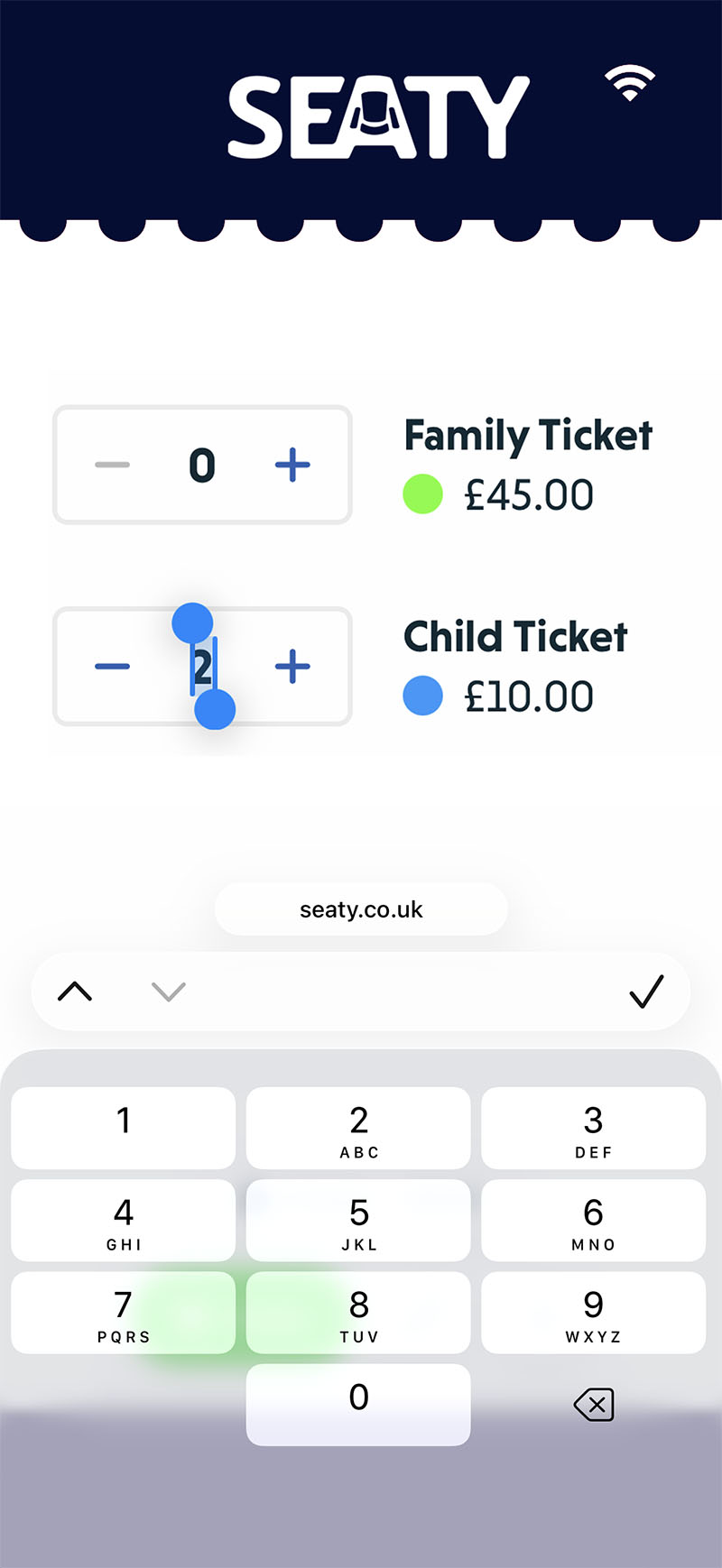
- Programmes sold the same way as tickets, with scannable vouchers redeemed on the night
- T-shirts, raffle tickets, refreshments, and other extras handled identically
- Sponsor and advertising income recorded against the production for treasurer reporting
- Front-of-house sees what has been sold and what is left in real time
AmDram treasurer's view: outstanding balances and Gift Aid.
What the books need to look like before the AGM

By the end of the run, the treasurer needs one view of the production: tickets sold, comps issued, balances still outstanding, donations marked for Gift Aid, programme and merchandise income, and an audit trail of every order change ready for the committee. Seaty puts that in one place and keeps it accessible for years afterwards, which matters when planning next season's budget. The outcome: end-of-year accounts ready for the AGM, not invented in the week before. Charity societies running fundraising productions will find Gift Aid detail in our related guides below.
Outstanding balances
One dashboard for who still owes the society money across the whole production
Gift Aid declarations
Eligible donations marked automatically with declarations kept against each order
Audit logs
Every order change recorded for committee reporting and end-of-year accounts
Multi-year history
Past productions, members, and finances stay accessible for next season
Where most ticketing platforms break for am-dram.
Reservations. If you are allocating tickets at the production meeting, generic platforms force you to either release everything publicly or manage reservations in a spreadsheet. Auntie's Thursday front row ends up on a clipboard or never gets held at all. Seaty holds the seat against a name and a balance, committee-approved, with payment due whenever the society agrees.
Member quotas. Most platforms have no concept of a member selling on behalf of the society. John's twelve tickets, the chorus's six each: there is nowhere for that to live, so it ends up in a notebook and the production manager guesses the running total at the next meeting. Seaty tracks it as a first-class workflow with statements emailed at the end of the run.
Per-ticket fees on comps. Most platforms charge per-ticket fees on every sale, including free comps. By opening night the dress rehearsal preview, the cast closing-night row, and the friends-and-family allocation have cost the society forty pounds before a paying audience walks in. Seaty's fee model is flat per online card transaction and zero on cash, cheque, or held reservations. See how UK ticketing fees actually work.
Cash and cheque as second-class citizens. Most platforms treat anything outside their checkout as something to be tolerated, often with a separate paid plan to handle it. Most am-dram societies still take a meaningful share through cash on the night, cheques through the treasurer, and bank transfers from members' families. Seaty is free in that case, with seating plans, quotas, scanning, balances, and reporting all available.
The work around the show. Rehearsal schedules, shared scripts and recordings, cast and crew management, audit logs the treasurer can put in front of the committee. Most platforms stop at the box office. Seaty starts there.
Free if the society is taking payments itself.
For societies that would also like to take card payments online, there is a simple per-transaction fee with no contract and no monthly minimum. The committee chooses whether to absorb it or pass it on at checkout.
For background on the different fee models you will see across UK ticketing platforms, see our guide on how UK ticketing fees actually work. Charity societies running fundraising productions should also read selling tickets for charity events, which covers Gift Aid on donations, the rules on what counts as a fundraising ticket, and how to keep the trail clean for the treasurer. Societies hiring a venue for the run will also find our notes for independent theatres useful when negotiating with the venue manager.
Tools for the work between auditions and opening night.
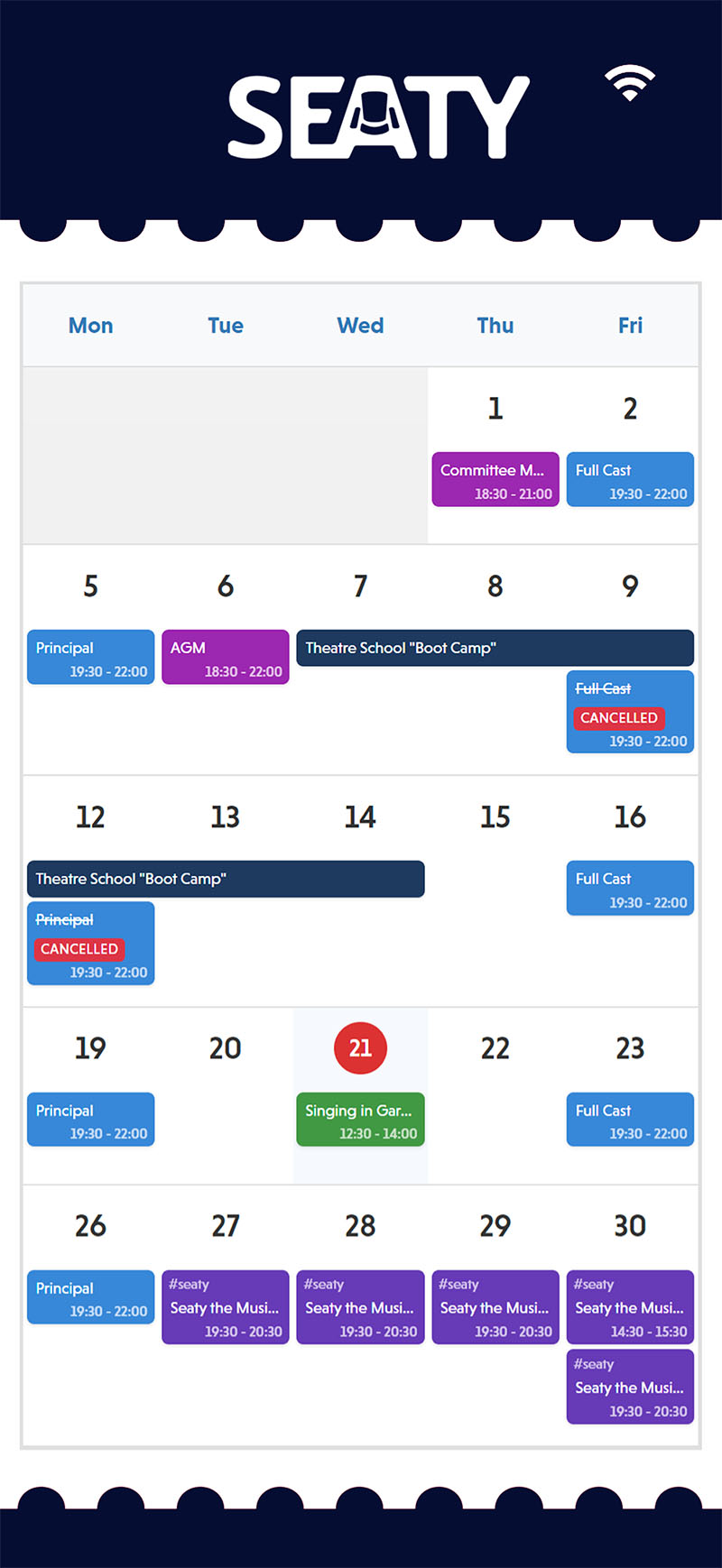
Read-throughs, blocking, music calls, dance calls, costume fittings, sitzprobes, tech runs, dress rehearsals. Schedule the lot in one place and let cast and crew see the calendar that applies to them. QR check-in tracks attendance for the production team, which matters most in the back end of the rehearsal period when calls are picky and absences disrupt staging. The outcome: the director knows who missed Tuesday's blocking call without having to ask around at the next rehearsal.
- Recurring weekly rehearsals with one-off calls layered on top
- QR check-in for cast and crew on arrival
- Attendance history per member for the production team
- Calendar views for production, month, week, or single day
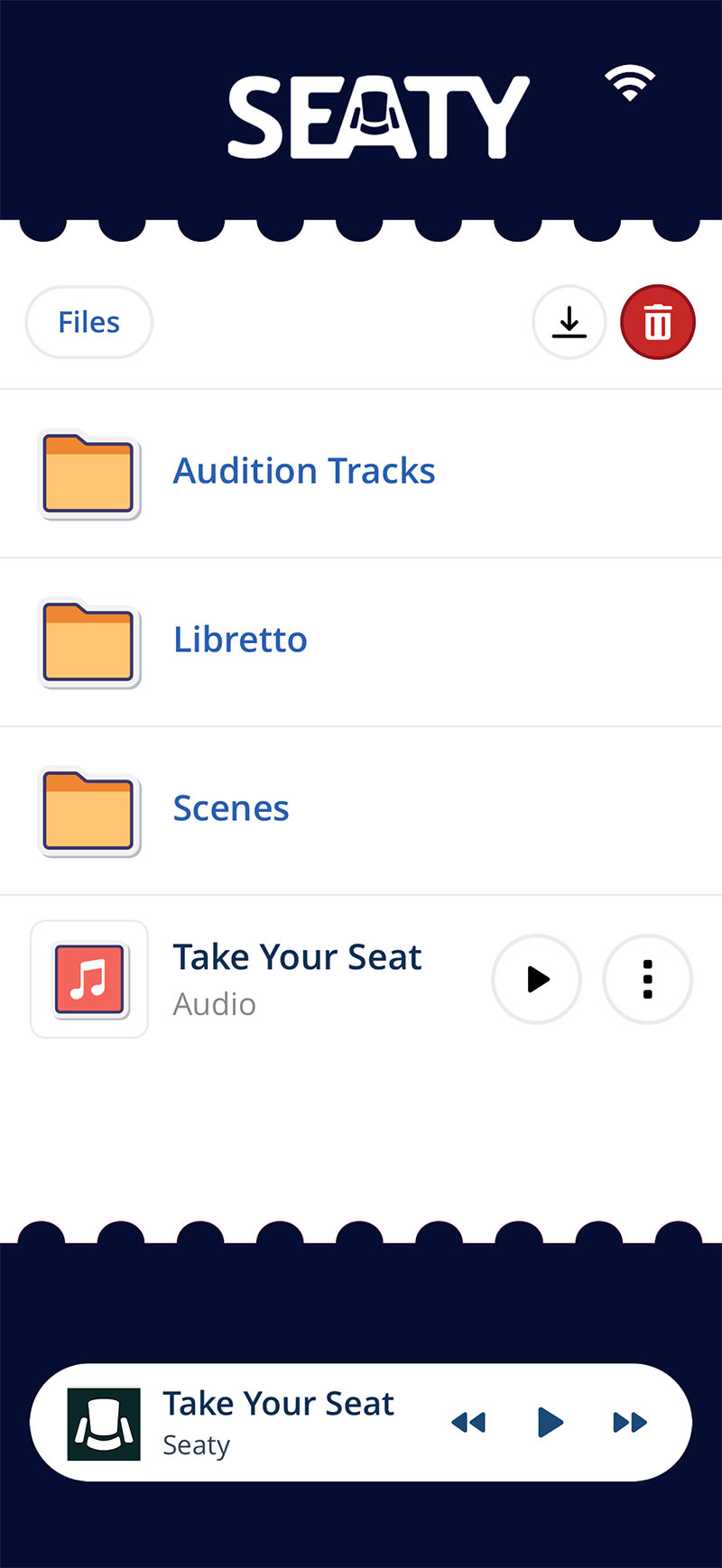
Scripts, sheet music, and rehearsal recordings for the cast.
Link Dropbox to share scripts, vocal lines, choreography videos, and sheet music with the cast. Audio and video play directly in the Seaty app, with offline access for the train home from rehearsal and pinning of specific moments in a track for the tricky entries. Useful in particular for musical theatre, where the same considerations apply as in choral society and orchestra rehearsals.