Setting up a seating plan for a small venue.
This is a hands-on guide. Not theory, not a sales page. What to actually do, in what order, written by people who have done it more times than they care to admit. If you would rather skip ahead to the related reserved versus general admission question first, that one is worth reading too. It shapes a lot of what follows.
Last updated 28 April 2026.
Reviewed against Approved Document B (gov.uk), the Equality Act 2010 (legislation.gov.uk), and the Regulatory Reform (Fire Safety) Order 2005 to the best of our knowledge at the time of writing. UK building regulations and venue safety rules vary by occupancy and venue, so always check Approved Document B and your venue's risk assessment for your specific event.
Start with the room, not a template.
1. Break the venue into named sections.
Stalls, Circle, Side, Standing

Once a venue gets past about forty seats, a single block of seating becomes hard for buyers to read. Break the room into named sections and treat each as its own mini-plan. Standard UK names work well because audiences already understand them: Stalls for the main floor, Circle for any raised tier, Side for the wings, Balcony for the upper level, Standing for any standing area. Sections also let you price differently: front Stalls higher than back Stalls, Side discounted because of partial sightlines.
- Use names buyers already understand (Stalls, Circle, Side) over invented codes (Block A, Zone 2)
- Keep each section visually distinct on the plan so buyers can orient themselves
- Match section names to real-world signage so ushers and audiences agree on where they are
- Price by section, not by individual seat, unless you genuinely have premium seats within a section
2. Pick a numbering convention and stick to it.
Letters for rows, numbers for seats

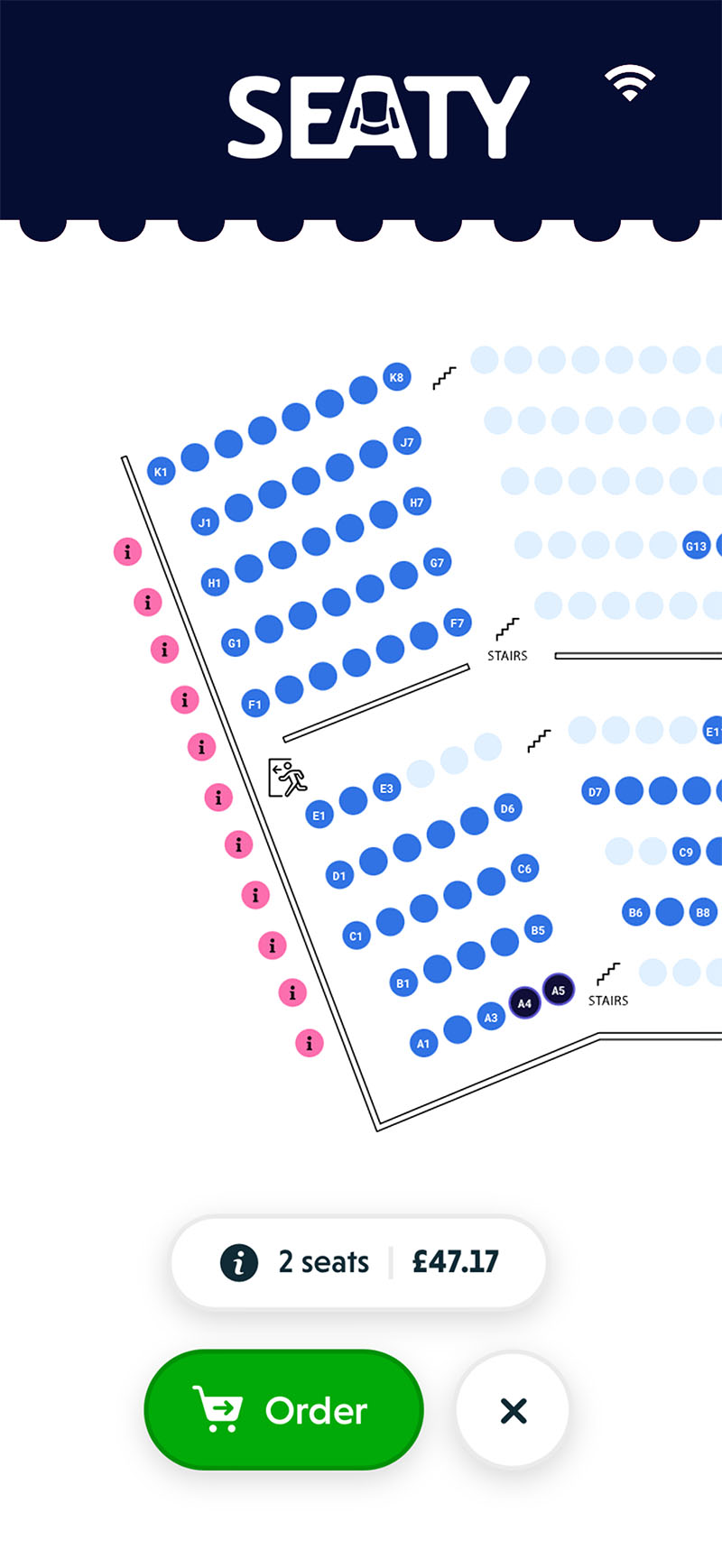
UK theatres traditionally use letters for rows and numbers for seats. Row A is nearest the stage and seats are numbered consecutively across each row. Two common approaches: continuous numbering across the whole house (1 to 200, left to right, regardless of section) or per-section numbering (Stalls A1 to A20, Circle A1 to A20). Per-section is far easier for audiences to navigate in a multi-tier venue. Continuous works in single-block halls. Pick one, apply it consistently, and never start numbering from the right in one row and the left in the next.
Continuous
Numbers run across the whole venue (1-200). Works for single-block halls without sections.
Per section
Each section restarts at A1 (Stalls A1, Circle A1). Easier for audiences in multi-tier venues.
Be consistent
Always number rows from the same side. Never alternate. Never skip numbers (no row 13 confusion is not worth the chaos).
Worked example: numbering Row F two different ways.
UK theatre (sequential). House left to house right, continuous: F1, F2, F3, F4, F5, F6, F7, F8, F9, F10, F11, F12, F13, F14, F15, F16, F17, F18, F19, F20, F21, F22, F23, F24, F25. Easy for audiences and ushers because the numbers always go up in one direction. This is what most UK theatres, village halls, and school halls use, and what we would recommend for almost every small UK venue.
Continental (centre-out). Seat 1 sits dead-centre. Even numbers run out to one side, odd numbers run out to the other. So Row F reads, from house left to house right: F25, F23, F21, F19, F17, F15, F13, F11, F9, F7, F5, F3, F1, F2, F4, F6, F8, F10, F12, F14, F16, F18, F20, F22, F24. Common in mainland European opera houses and a handful of older UK venues. Easier to understand the importance of a "good" seat (the lower the number, the more central) but baffling for audiences who have not seen it before.
Whichever you choose, the cardinal rule is the same: every row in the venue uses the same direction. Numbering Row A left-to-right and Row B right-to-left is the single fastest way to ruin an opening night.
A quick checkpoint.
3. Sightlines and restricted view seats.
Be honest about what each seat can see

Pillars, sound desks, lighting rigs, and railings hide parts of the stage from some seats. Walk every row before you publish the plan and sit in the seats that look suspect. If a seat genuinely cannot see all of the playing area, mark it as restricted view, discount it, and say so plainly in the listing. Buyers respect honesty and resent surprises. The worst thing you can do is sell a seat behind a pillar at full price and let the customer find out at the interval. They will not come back, and they will tell everyone they know.
- Sit in every seat that might be obstructed before publishing the plan
- Mark restricted view seats clearly on the buyer-facing plan, not just in your own notes
- Discount restricted view seats; somewhere between 25% and 50% off is typical
- Be specific in the description (e.g. "pillar partially blocks stage left")
4. Aisle widths and fire safety.
Approved Document B and your venue's risk assessment

Fire safety, escape routes, gangways, row lengths and capacity should be checked against the current Approved Document B (the statutory guidance to the Building Regulations on fire safety for buildings other than dwellings, Volume 2), your venue licence, and your local authority or fire officer's advice. The exact figures depend on capacity, layout, and the distance to the nearest exit, and they are revised periodically. Do not rely on a ticketing seating plan as a compliance document, and do not hard-code a number you read on a blog. The Regulatory Reform (Fire Safety) Order 2005 places a duty on the responsible person for the premises to carry out a suitable and sufficient assessment of the risks (Article 9), and requires that emergency routes and exits are kept clear, sized for the maximum number of people present, and lead as directly as possible to safety (Article 14). Larger venues, raked seating, and licensed premises have stricter requirements. If in doubt, your local fire officer would much rather answer a polite question in advance than write a report afterwards.
- Treat aisle widths, row lengths, and capacity as venue-specific calculations. Approved Document B Volume 2 is the source, and your venue licence and risk assessment apply on top
- Never block fire exits with seats, AV stands, or merch tables, even temporarily (Regulatory Reform (Fire Safety) Order 2005, Article 14)
- Limit the number of seats between aisles to whatever your venue's licence and risk assessment require, rather than relying on a generic figure
- If you are altering the venue's normal layout (extra rows, removed chairs), revisit the fire risk assessment as required by Article 9 of the Regulatory Reform (Fire Safety) Order 2005
5. Accessibility seating, planned in from the start.
Equality Act 2010 reasonable adjustments
Designate explicit wheelchair spaces on the plan (typically at the end of rows nearest accessible entrances, with step-free routes from the door) and place at least one companion seat directly next to each. Do not bury accessibility in the plan and hope nobody asks. Under the Equality Act 2010, a venue or event organiser providing a service to the public is a service-provider for the purposes of Section 29, and Section 20 imposes a duty to make reasonable adjustments where a provision, criterion or practice (or a physical feature) puts a disabled person at a substantial disadvantage. Pre-allocating accessible spaces is the bare minimum. Price them sensibly (the same as adjacent seats, never more), make them easy to spot on the public plan, and brief your front-of-house team so they are not improvising on the night. If you wait until the plan is published to think about accessibility, you will find it almost impossible to insert a wheelchair space later without renumbering whole rows.
Wheelchair spaces
End of rows, near accessible entrances, with step-free access from the door. Reserved on the plan, not improvised.
Companion seats
At least one directly next to each wheelchair space. Travels with the accessible booking.
Sensory and mobility
Aisle seats near exits for assistance dogs, hearing loop coverage, seats with extra legroom for limited mobility.
Worked example: 150-seat community hall, end-on staging.
Layout. Six rows of twenty-five chairs, lettered A through F (A nearest the stage). Seats numbered F1 to F25 from house left to house right, the same direction in every row. A central aisle splits each row into two banks of twelve, with seats 12 and 13 either side of the aisle. Two side aisles run the length of the hall against the walls.
Accessibility. Two wheelchair spaces at the back of row F, replacing what would otherwise have been seats F12 and F13. Closest to the rear accessible entrance and with the shortest, flattest route from the door. Companion seats at F11 and F14, next to each wheelchair space. The accessible loo is signposted from front-of-house.
Holds. Ten seats held back across rows D and E (typically D12, D13, D14, E12, E13, E14, plus four scattered through the side seats) to cover comp tickets for the cast's families, late group bookings, and anyone who needs to be moved on the night. Released to general sale 48 hours before the show if not used.
Capacity check. 150 chairs minus two for wheelchair spaces equals 148 seated, plus 2 wheelchair positions, total 150 audience. Whether 150 is your safe capacity depends on the hall's fire risk assessment. Do not assume the chair count and the legal capacity are the same number.
Worked example: 80-seat studio theatre, in-the-round.
Layout. Four banks of seating, named for the points of the compass: North, East, South, West. Each bank has four rows of five seats. Row 1 is closest to the stage in every bank (so North row 1 is actually on the opposite side of the playing area from South row 1, facing each other across the action). Seats numbered 1 to 5 in each row.
Accessibility. Wheelchair spaces at the back of bank North, row 4, replacing two seats and sitting on a level platform with step-free access from the studio's only step-free entrance. Companion seats adjacent. If you have only one accessible bank, make sure the marketing copy says so explicitly so customers do not assume they can sit anywhere.
Sightlines. In-the-round means actors are always facing away from someone. Be honest about which seats see less of the action during scripted scenes (typically the seats furthest from the entrances the cast use most). You may decide every seat is equal price, or you may discount some banks. Either is defensible. What is not defensible is pretending all seats are equivalent when they obviously are not.
Practical note. In-the-round venues need clearer numbering than end-on venues, because audiences cannot use "facing the stage" as a frame of reference. Bank-name + row + seat (e.g. "East row 2 seat 3") is much easier to communicate than a single continuous numbering across the whole studio.
6. Hold back five to ten per cent for emergencies.
Comp tickets, accessibility, last-minute fixes
Always keep some seats unsold. You will need them for last-minute accessibility requests that did not come through booking, complimentary tickets for press, governors, sponsors, the building owner and the cast's families, group bookings that arrive late, and the inevitable booking error that needs fixing without bumping a paying customer. For most events, five to ten per cent of the house held back works well. You can always release held seats a day or two before the show if demand is strong. What you cannot do is conjure them up once they are sold.
- 5-10% of the house is a sensible default for held-back seats
- Hold back accessible spaces specifically; do not just rely on a percentage
- Reserve a small block at the back for late group bookings or fixes
- Decide press and cast-comp numbers up front so you are not negotiating on opening night
- Release unused holds 24-48 hours before the event if demand is strong
Where seating plans go wrong.
Numbering inconsistencies between rows. Row A numbered left-to-right, Row B numbered right-to-left because it felt more natural at the time. Confuses everyone: audiences, ushers, the box office. Pick one direction and apply it to every row.
Inconsistent numbering between left and right halves of rows in continental layouts. If you are using a continental centre-out plan, every row must follow the same odd-on-one-side, even-on-the-other pattern. Switching halfway through the auditorium is the easiest way to send people to the wrong seat.
Forgetting accessibility seats until the plan is published. Wheelchair spaces and companion seats need to be designed in from the start. Trying to insert them after rows are numbered usually means renumbering an entire bank, which then invalidates every ticket already sold.
Treating wheelchair spaces as "extras" rather than designated and pre-allocated. A wheelchair space is not a removable seat the box office finds on the night. It is a position on the plan, sold explicitly, with a companion seat next to it.
Forgetting companion seating next to wheelchair spaces. The companion ticket should travel with the accessible booking by default. Asking a wheelchair user to book one ticket and a companion to book a different ticket and hope for the best is exactly the kind of barrier the duty to make reasonable adjustments in Section 20 of the Equality Act 2010 is intended to remove.
Not marking restricted-view seats. The customer service issue. The refund risk. The damaged reputation. Mark them, discount them, describe them. Do not hide them.
Miscounting fire capacity. The number of chairs in the room is not the legal capacity. Capacity is set by the venue's fire risk assessment (a duty under Article 9 of the Regulatory Reform (Fire Safety) Order 2005), the means of escape requirements in Article 14 of that Order, and the guidance in Approved Document B, not by how many you can physically fit. Get this wrong and you are creating a legal and safety problem, not just a paperwork one.
No hold-back seats for press, comps or cast. You sell out by Tuesday, then on Friday a sponsor asks for four seats, the local paper asks for two, and the lead actor's parents have flown in from Australia. Without holds, you are now bumping paying customers, or saying no to the people you needed to say yes to.
Plans that do not match the physical room. The pretty grid you drew on a screen with twelve rows of equal width is not actually possible because of the pillar, the radiator, and the fact that row K only has space for nine chairs not twelve. Walk the room.
Section names that mean nothing to buyers. "Block C" does not help the grandmother booking for the whole family. Stalls, Circle, Side and Standing do.
Building the plan on a desktop and never opening it on a phone. Most bookings happen on phones. A plan that looks beautiful on a 27-inch monitor can be unusable on a 6-inch screen.
7. Test the plan before you publish.
Mock bookings, phone checks, fresh eyes
Before you make the plan live, run a full mock booking from start to finish. Pick seats, get to checkout, look at the confirmation email. Sit in a few different seats yourself (the front row, the corner of row K, the restricted-view seat) and check the description matches the experience. Then ask a friend who has never seen the plan to navigate it without help: if they hesitate, the plan is not clear enough. Finally, do all of it again on a phone. If the booking flow is awkward on a small screen, fix it before launch, not after.
- Run a mock booking from search to confirmation email
- Sit in a sample of seats yourself and verify the descriptions
- Ask someone unfamiliar with the plan to book a specific seat without help
- Open the plan on a phone; most bookings happen there
A practical checklist before you publish your plan.
2. Broken the room into named sections that match real-world signage (Stalls, Circle, Side, Standing).
3. Picked one numbering convention (continuous or per-section, sequential or continental) and applied it consistently across every row.
4. Sat in every potentially-obstructed seat and marked restricted-view seats with honest descriptions and sensible discounts.
5. Aisle widths cross-checked against the venue's risk assessment and Approved Document B for the actual audience size, not assumed from a generic figure.
6. Wheelchair spaces and companion seats explicitly designated, near accessible entrances, priced fairly.
7. Five to ten per cent of the house held back for accessibility, comps and fixes, with press and cast-comp numbers agreed in writing.
8. Mock booking completed end-to-end, on both desktop and phone, by you and a fresh pair of eyes.
Once the drawing is right.
For the Seaty product specifics, the documentation pages on setting up a seating plan and locking seats for box office walk through how each of those capabilities works in practice.
If your situation is more specific...
If you are an independent theatre running multiple configurations across the year (end-on for the autumn play, traverse for the studio season, in-the-round for the Christmas show), see notes for theatres on managing several plans for a single venue.
If you are a dance school hiring a regional theatre for the annual recital, where parents expect specific seats and accessible spaces fill quickly, see notes for dance schools on group bookings, comp tickets and parent-friendly layouts.
If you are an amateur dramatic society in a community hall with stacking chairs rather than fixed seating, see notes for amateur theatre on building a plan that survives the chairs being put away between productions.
Related guides and documentation
Sources & further reading
Building and fire safety
Approved Document B: Fire Safety, Volumes 1 and 2 (gov.uk)
Regulatory Reform (Fire Safety) Order 2005 (legislation.gov.uk)
Article 9: Risk assessment (legislation.gov.uk)
Article 14: Emergency routes and exits (legislation.gov.uk)
Accessibility
Equality Act 2010 (legislation.gov.uk)
Section 20: Duty to make reasonable adjustments (legislation.gov.uk)
Section 29: Provision of services, etc. (legislation.gov.uk)
EHRC guidance on services, public functions and associations (equalityhumanrights.com)